Why I built transformable: staying within the rules of self-hosted apps

If you’ve spent any time exploring self-hosted tools, you’ve probably run into a pattern: The software is open, powerful, and flexible but the moment you try to offer it as a service to others, things get complicated.
That’s exactly the problem we set out to solve with transformable.app.
The Reality of Self-Hosted Isn’t Always What It Seems
Tools like n8n are a great example. It’s an incredible workflow automation platform that you can run yourself, with full control over your data and infrastructure.
But there’s an important nuance in how self-hosted is intended to work.
n8n uses a fair-code license that allows you to run the software freely for your own internal use but restricts offering it as a hosted product for others without proper licensing.
In practice, that means:
- You can run n8n for your own business
- You can set it up for a client
- But the instance should ultimately be owned and controlled by that client, not bundled into your own SaaS offering
There’s even community guidance that reinforces this model: clients should have their own server or environment, with a clear separation between provider and customer.
This is where many agencies and builders hit a wall.
The Problem: Great Tools, Awkward Deployment Models
If you’re building for clients, you end up choosing between:
❌ Violating license terms (even unintentionally)
❌ Hand-rolling infrastructure for every project
❌ Managing fragmented deployments across different clouds
❌ Or avoiding powerful tools altogether
And on top of that, self-hosting requires real infrastructure knowledge: servers, containers, security, scaling.
So while the tools are accessible the deployment model isn’t.
The Idea Behind transformable.app
Transformable.app exists to bridge that gap. Instead of hosting software for your clients, it helps you:
👉 Provision and deploy directly into infrastructure your client owns
That’s the key difference.
What Makes transformable.app Different
With Transformable.app, you’re not spinning up apps on someone else’s platform, you’re orchestrating deployments into:
- Your or Your client’s VPS/cloud account at Akamai, DigitalOcean, AWS, Oracle
- Infrastructure you and your clients fully control and pay for
This aligns perfectly with how tools like n8n are meant to be used. Because at the end of the day: for self-hosted software, where it runs matters just as much as how it runs.
Built on Proven Infrastructure Patterns
Transformable.app doesn’t reinvent deployment, it packages what already works:
- Infrastructure provisioning (Laravel Forge API)
- Containerized deployments (Docker and Portainer-based stacks)
- Repeatable configurations
- Secure, isolated environments per client
Instead of reinventing DevOps for every project, you get a consistent, tested, repeatable system.
Why This Matters (More Than Ever)
Self-hosted software is growing fast for a reason:
- Better data ownership
- Predictable costs (you just pay for your VPS)
- More flexibility than SaaS
But licensing models are evolving too and many tools are explicitly designed to prevent being resold as hosted services.
Transformable.app embraces that reality instead of fighting it.
A Better Model for Agencies and Builders
With transformable.app and Laravel Forge, you can:
- Stay compliant with licensing terms
- Deliver production-ready deployments
- Give clients full ownership of their infrastructure
- Still move fast using standardized workflows
You’re not selling access to software.
You’re delivering infrastructure + implementation. Transformable.app was built to make that ownership practical at scale. If you’re working with tools like n8n (or planning to), transformable.app helps you do it the right way from day one.
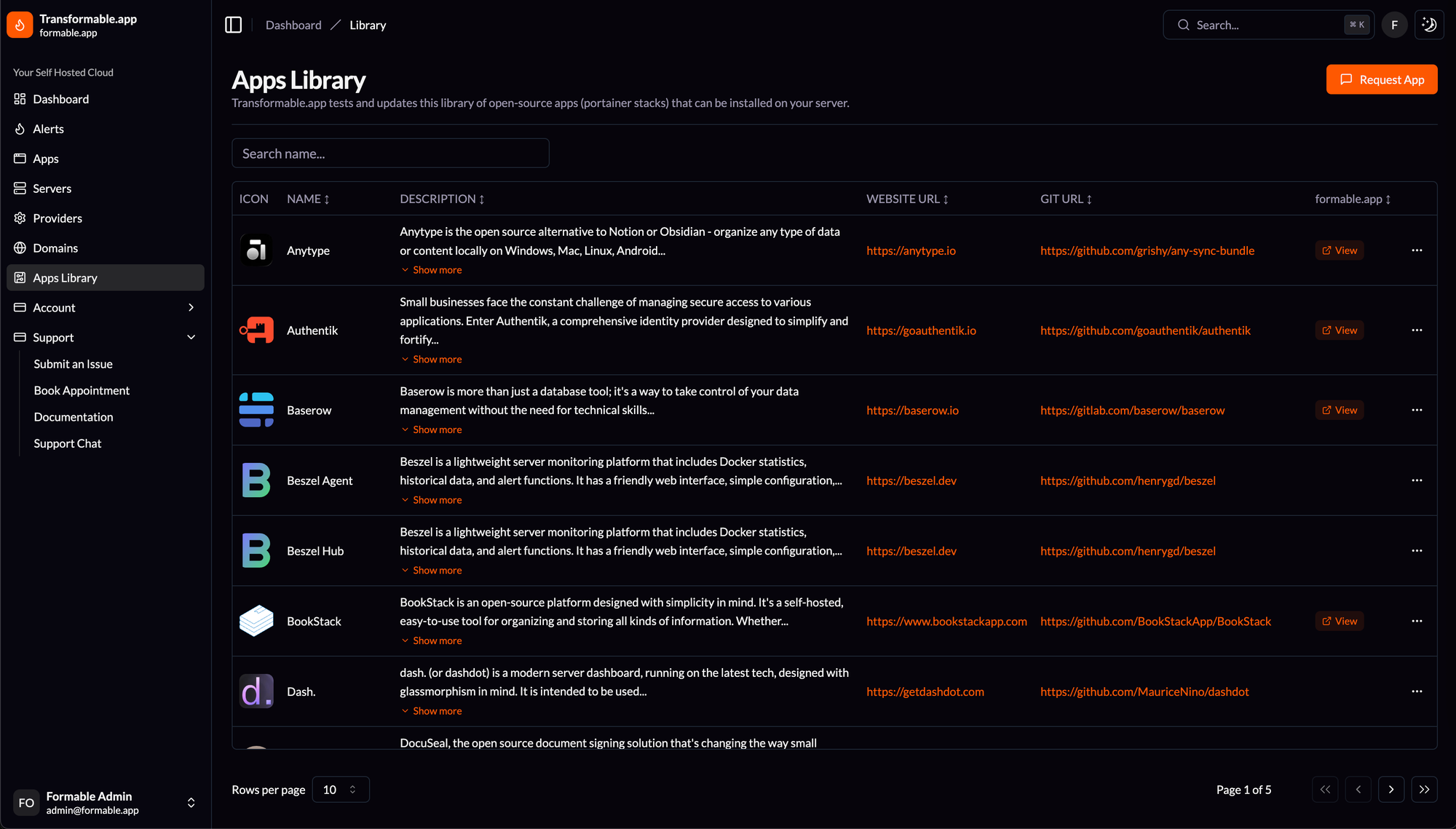
Want to get started now? Use transformable.app to quickly deploy a rootless Docker Ubuntu Server and install tested Portainer stacks from our apps library.